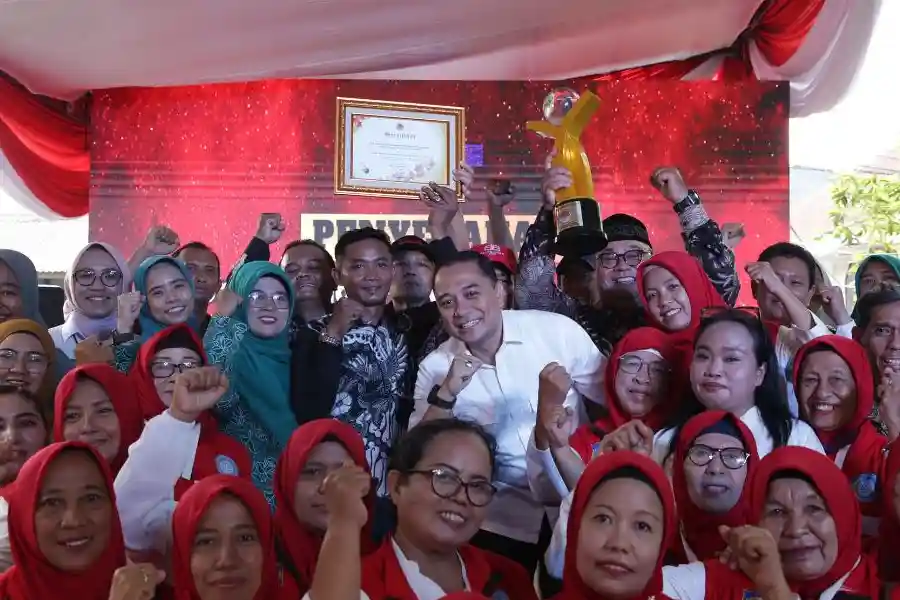
Surabaya (beritajatim.id) – Twenty-three villages in Surabaya have been honored with the 2024 Program Kampung Iklim (ProKlim) Award from the Ministry of Environment and Forestry (KLHK). This prestigious recognition acknowledges the communities’ commitment to climate change adaptation and mitigation efforts within their neighborhoods.
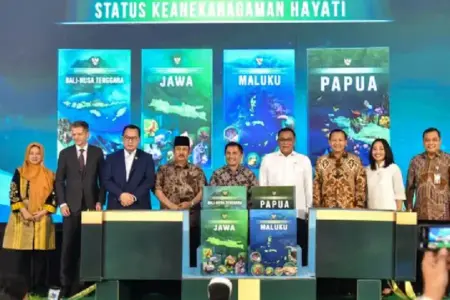
The awards were presented by the Minister of Environment and Forestry, Siti Nurbaya, during the culmination of the LIKE 2 Festival in Central Jakarta on Friday, August 9, 2024. This year, the KLHK divided the nominations into two categories: the highest distinction, ProKlim Lestari, and the ProKlim Utama.
Surabaya Mayor Eri Cahyadi expressed his pride and appreciation for the hard work of the residents and various stakeholders who contributed to this achievement. He emphasized that this success is a result of collaboration between the community, government, and stakeholders in creating a better environment.
“We are immensely proud and grateful to all the citizens who have worked tirelessly to make Surabaya an environmentally conscious city. This award is a motivation for us all to continue protecting and improving our environment,” Mayor Eri Cahyadi stated on Sunday, August 11, 2024.
Two Surabaya villages, Kelurahan Pagesangan and RW 1 Banjar Sugihan, received the highest honor, the ProKlim Lestari Trophy, from the KLHK. “To achieve ProKlim Lestari status, a village must mentor 10 ProKlim Utama,” Eri added.
In addition to the ProKlim Lestari awards, 21 other villages in Surabaya received the ProKlim Utama Award. The Surabaya City Government also received a Certificate of Appreciation for ProKlim Mentoring 2024 from the KLHK, recognizing the city’s active participation in ProKlim development.
Dedik Irianto, Head of Surabaya’s Environmental Agency (DLH), highlighted the factors that contributed to the success of the two villages in achieving the ProKlim Lestari status. He pointed out that innovative practices that positively impacted the environment and improved the quality of life of residents played a significant role.
“For example, Kelurahan Pagesangan successfully transformed a former illegal dumping site under the toll road, known as ‘Getol’ (Gesang Bawah Tol), into a productive green space that now serves as a vegetable garden for food security,” Dedik explained.
He also mentioned the “Gerakan Balik Kanan” (Geblak) initiative in Pagesangan, where houses that previously faced away from the river were reoriented to face it. “This has led to greater environmental awareness among riverside residents,” Dedik said.
Kelurahan Pagesangan has also become an environmental management laboratory, frequently visited by students and the public who want to learn about wastewater treatment and waste management. The village’s multifunctional retention pond serves as both a flood prevention measure and a fishing spot for locals, providing both ecological and economic benefits.
Meanwhile, RW 1 Banjar Sugihan has transformed into an innovative thematic village where residents utilize vacant land to grow vegetables. “The produce not only meets nutritional needs but also contributes to reducing stunting,” Dedik added.
Dedik noted that the circular economy created by the adaptation and mitigation efforts in RW 1 Banjar Sugihan has had a positive impact. “These innovations not only protect the environment but also boost the local economy,” he explained.
The 21 other ProKlim Utama-winning villages in Surabaya have also been recognized for effectively using available land for food security, such as vegetable farming and fish cultivation. These villages are also active in waste management, energy conservation, and water conservation through the use of solar cells, wastewater treatment plants (IPAL), and LED lighting.
“Residents have also managed to address local vulnerabilities by creating biopores and proper water management channels, effectively preventing flooding,” Dedik noted.
He concluded by expressing the city government’s hope that the number of ProKlim Lestari villages in Surabaya will continue to grow. “We hope that the 23 award-winning villages will inspire other communities to innovate and sustain their efforts,” Dedik concluded. (hdl)
 as a preferred source on Google